
Yacht Advisor · Dubai
Patric Daccache Independent Yacht Advisor and Market Analyst.
I help yacht owners, sellers, buyers and brokers understand how a yacht is positioned in the market before pricing, listing, buying or negotiating.
Founder of Yacht Advisor and YachtAddress. Published in SuperYachtNews. Followed by 4500+ industry professionals on LinkedIn.
Book
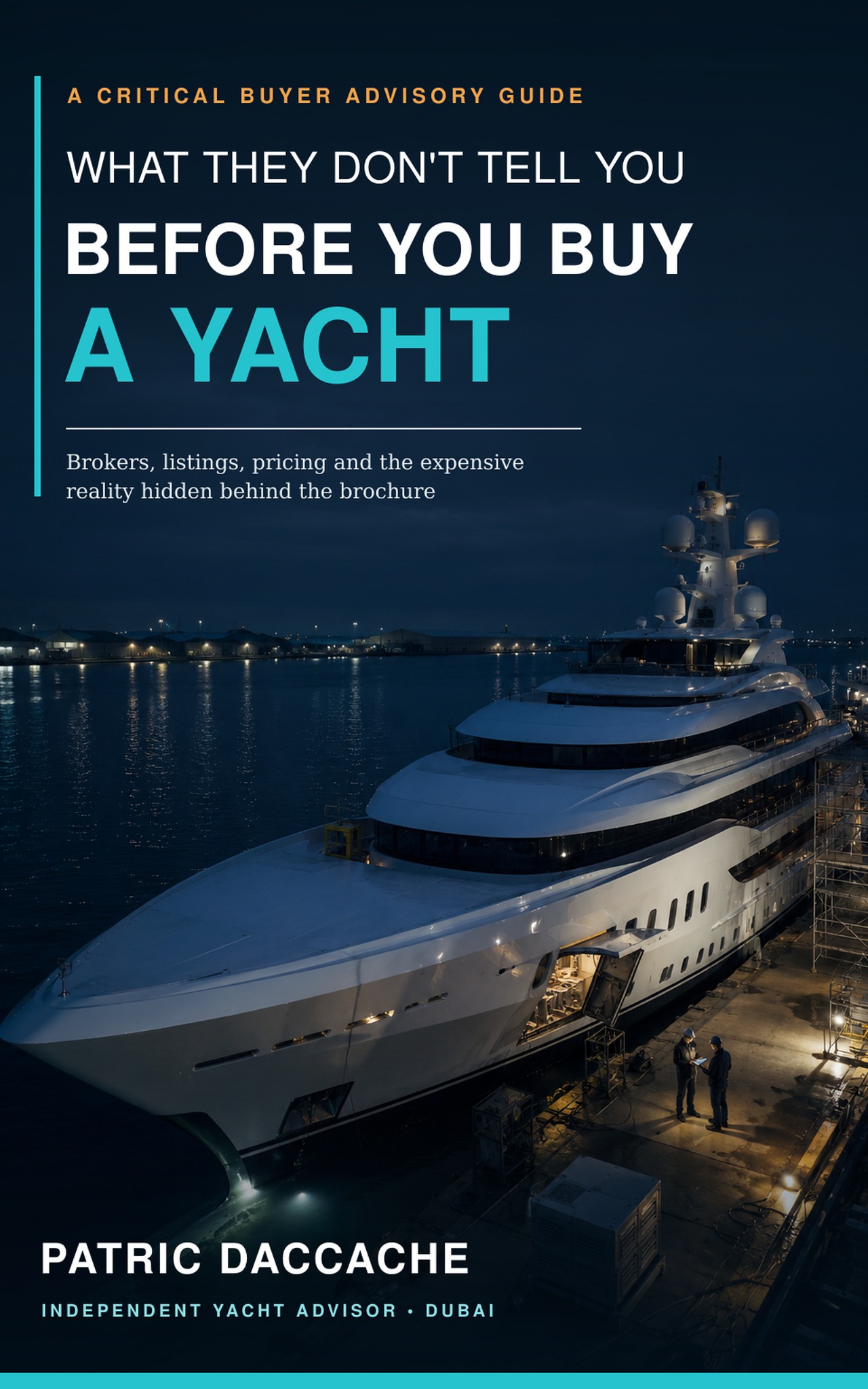
What They Don't Tell You Before You Buy a Yacht
My critical buyer advisory guide examines broker incentives, listing language, pricing, refit claims, due diligence and the expensive realities that polished marketing tends to leave outside the frame. It is written for buyers, owners, family offices and people entering the yachting industry.
English edition · eBook and hardcover · More than 300 pages in hardcover
Explore the BookMedia
Published in SuperYachtNews
I have been published in SuperYachtNews with views on the yacht market, owner behaviour and listing strategy.
View Media
Yacht Advisor
Advisory delivered through Yacht Advisor.
Yacht Advisor is my independent analysis service for yacht listings, pricing reality checks and market positioning. It combines market data, listing context and advisory judgement into a clear report that owners, sellers and brokers can use before making decisions.
Explore Yacht Advisor
YachtAddress
The digital side of how yachts are presented and sold.
I also founded YachtAddress, a specialist digital studio for yacht brokerages and active yacht listings. We build dedicated yacht sales microsites, brokerage websites and listing campaigns around the way buyers actually encounter a yacht online.
That work gives me a second view of the market. Through Yacht Advisor I analyse pricing, positioning and buyer perception. Through YachtAddress I work on what the buyer actually sees: the story, imagery, specification, documents, mobile experience and the path from a broker message or QR code to an enquiry.
A yacht may be a multi-million-euro asset. Its digital sales layer should not be treated like a one-off website project.
What I Do
Three areas of focus.
Yacht Listing Analysis
Independent review of pricing, market position, competing listings, presentation and buyer perception.
See how listing analysis worksYacht Sale Control
Structured oversight of an active yacht sale, including positioning, broker activity, market feedback and corrective actions.
See how sale control worksGCC Broker Support
Local execution and market support in Dubai and the wider GCC while the broker retains the mandate and client relationship.
See how broker support worksSample Output
What the written analysis shows.
Each engagement produces a structured decision document. The example below shows the type of work covered, not a client result.
Yacht Listing Analysis
Illustrative format · No client data
Market position
Where the yacht currently sits in its segment, and how that position is read by the buyers actually active in it.
Pricing logic
The reasoning behind the asking price, the band the segment supports and where expectation and market diverge.
Direct comparable yachts
The specific yachts a buyer weighs against this one, and what those comparisons say about relative standing.
Listing and presentation signals
How the listing, imagery, specification and time on market are interpreted before an enquiry is ever made.
Recommended actions
A short, ordered set of next steps: what to correct, what to hold, and what to test in the market before the next decision.
Why It Matters
The yacht market often looks cleaner from the outside than it feels inside the deal. Asking prices, seller expectations, buyer psychology, broker narratives and market data rarely move in a straight line. My work focuses on turning that noise into a clearer decision.
How I Work
Written, independent, direct.
Every engagement produces a written view the client can use immediately. The tone is factual, the analysis is independent, and the recommendation is one the owner, representative or broker can act on without re-interpretation.
Independent
No commission tied to a transaction. No listing inventory. No preferred broker to route work to.
Written
The output is a document, not a conversation. It survives past the meeting and travels between the family office, the representative and the broker.
Direct
The analysis does not flatter and does not promote. It tells the owner where the position stands, so the next decision is a better one.
Who I Work With
Owners, representatives, brokers.
The typical client is the owner of a superyacht 30m and above, a family office managing yacht assets on behalf of a principal, a representative preparing a listing decision, or a broker who wants an independent second view before recommending a move.
The engagement runs alongside the existing team. The broker continues to represent the seller. The captain continues to run the yacht. The family office continues to manage the wider portfolio. The advisory work adds one independent voice to that structure, not a replacement for any of it.
Featured Insight
"A yacht does not just need exposure. It needs the right market position. If the pricing, timing and buyer logic do not align, more visibility only makes the problem more visible."
Read Market NotesFAQ